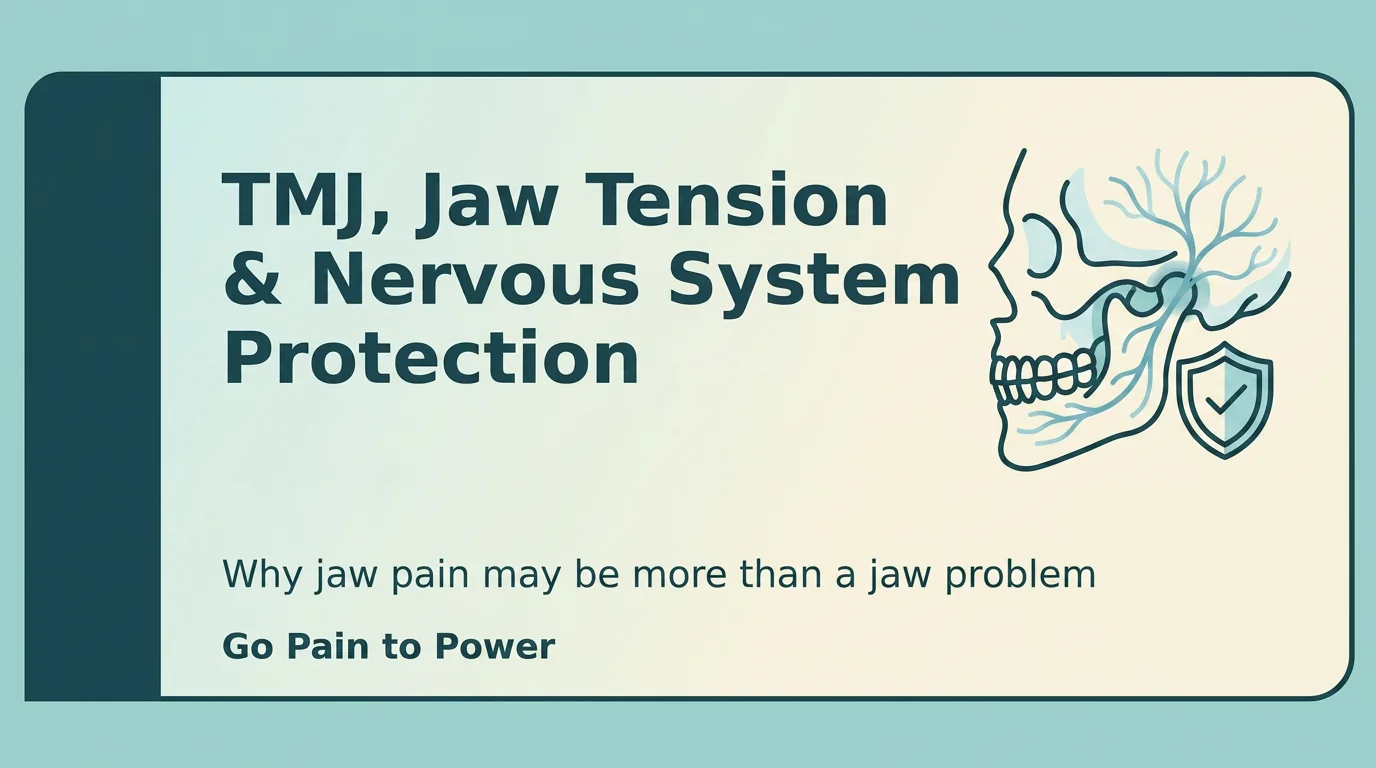
When people say they have “TMJ,” they usually mean jaw pain, jaw tension, clicking, clenching, headaches, or discomfort around the jaw joint. Technically, TMJ stands for the temporomandibular joint itself. But in everyday language, most people use “TMJ” to describe the whole pattern of jaw symptoms.
What many people do not realize is that jaw tension is not always just a jaw problem.
Sometimes the jaw is part of a larger nervous system protection pattern. The body may be bracing, guarding, clenching, or holding tension because it does not feel fully safe, settled, or regulated.
Why the jaw holds so much tension
The jaw is closely connected to stress, breathing, posture, neck tension, and the fight-or-flight response. When the nervous system is under pressure, the body often looks for places to hold that pressure. For many people, the jaw becomes one of those places.
That can show up as:
-
jaw clenching during the day
-
grinding at night
-
clicking or popping
-
tightness near the temples
-
neck and shoulder tension
-
headaches
-
difficulty relaxing the face
-
a feeling that the jaw never fully lets go
Of course, jaw symptoms can have many causes. Dental issues, bite mechanics, trauma, orthodontic history, sleep quality, posture, and inflammation can all matter. This is why it is important to work with the right medical or dental professional when symptoms are persistent or severe.
But there is another layer that often gets missed: the nervous system.
The jaw may be guarding, not just malfunctioning
At Go Pain to Power, we often look at symptoms through the lens of protection mode. Protection mode is the body’s way of trying to keep you safe. It is not a failure. It is not weakness. It is the nervous system doing what it believes is necessary.
If your system has been under stress for a long time, the jaw may become part of that protective strategy. The muscles may stay active because your brain and body have learned that holding tension equals readiness.
That is why simply telling yourself to relax does not always work.
If the nervous system still senses threat, the jaw may keep bracing no matter how much you stretch, massage, or consciously try to let go.
Why stress and jaw pain often go together
Many people notice their jaw symptoms worsen during stressful seasons. That is not random. Stress can change breathing patterns, increase muscle tone, disrupt sleep, and keep the body in a higher state of alert.
When the body is stuck in that state, the jaw can become a pressure valve.
You may not feel “stressed” emotionally, but your body may still be acting like it is preparing for impact. That can show up as tight shoulders, shallow breathing, clenched teeth, a guarded neck, or a jaw that feels locked in place.
A nervous-system approach to TMJ symptoms
A nervous-system approach does not mean ignoring the jaw. It means asking a better question:
What is the jaw protecting me from?
Instead of forcing the jaw to release, we work with the body in a way that may help the nervous system feel safe enough to let go. This can include breath, gentle touch, sensory input, movement, body awareness, and regulation-based strategies.
The goal is not to overpower the body. The goal is to help the body stop needing so much protection.
Signs your jaw tension may involve the nervous system
Your jaw symptoms may have a nervous-system component if you notice patterns like:
-
symptoms worsen when life is stressful
-
you clench more when concentrating
-
your jaw feels tight even when dental work looks normal
-
neck and shoulder tension show up with jaw symptoms
-
you wake up with jaw tightness after poor sleep
-
massage helps temporarily but the tension returns
-
you feel like your body is always “on”
These patterns do not prove one single cause. But they can point to a deeper regulation issue worth exploring.
What we focus on at Go Pain to Power
Our work is built around the idea that pain and tension can be connected to protection patterns in the brain and body. With jaw tension, we may look at the jaw itself, but we also look at the neck, breath, shoulders, posture, stress response, and the body’s ability to shift out of high alert.
Some people notice they feel calmer, lighter, more mobile, or more connected to their body after nervous system work. Results vary, and this is not a replacement for dental or medical care. But for people who feel stuck in chronic tension patterns, it can be a powerful place to start.
If your jaw will not let go
If you have been dealing with jaw pain, clenching, clicking, or TMJ symptoms, your body may not need more force. It may need a different signal.
Sometimes the question is not, “How do I force this muscle to relax?”
Sometimes the question is, “How do I help my nervous system feel safe enough to stop bracing?”
That is the kind of question we explore at Go Pain to Power.
Ready to explore a nervous-system approach? Schedule a session here: https://gopaintopower.com/schedule-page
Educational only. This is not medical or dental advice. If you have persistent jaw pain, injury, locking, swelling, dental concerns, or severe symptoms, please consult a qualified healthcare or dental professional. Individual results vary.
Learn how sessions work, meet the practitioners, or book a session.