Back pain after spinal cord injury was part of Tom’s daily life, alongside significant difficulty getting upright and loading his right leg. During a remote session on August 10, 2026, he noticed that getting up felt easier, standing felt more stable at one point, and straightening his legs became a little easier. In an October 8 phone update relayed by Shankar, Tom’s back pain was reported to be substantially less.
The story starts with an everyday task: getting out of a chair and standing. For Tom, the effort involved made even a small change worth noticing.
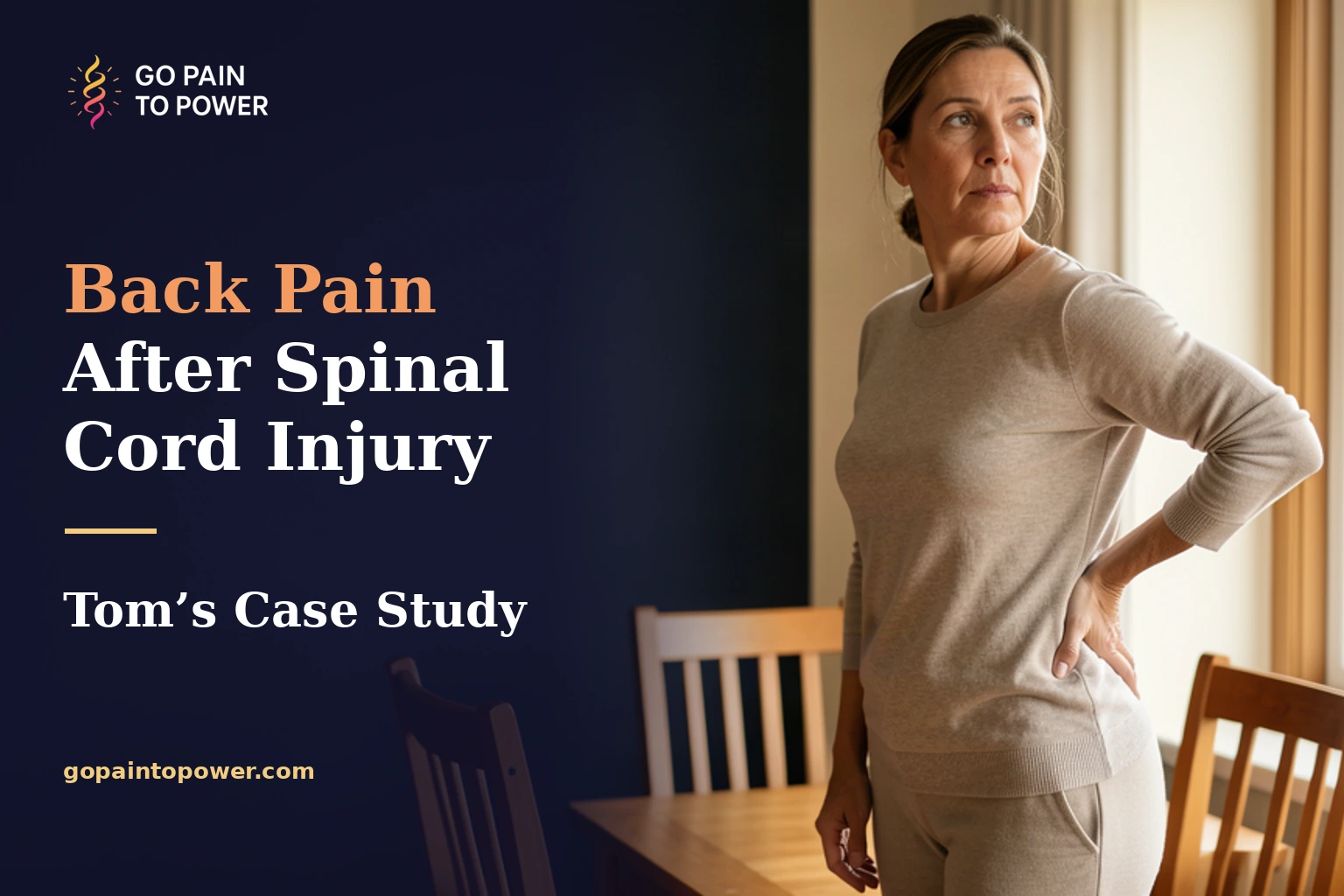
Cover image: an illustrative AI-generated back-discomfort scene, not a photograph of Tom.
Living with back pain and difficulty standing
Tom described living with a spinal cord injury for several years. He used a rollator for short distances and a wheelchair for longer ones. Standing was already possible, but his right leg tended to bend and was difficult to load comfortably. Getting upright took effort.
He also described intermittent lower-back pain, discomfort after prolonged sitting, and greater difficulty on days following poor sleep. Muscle spasms around falling asleep and waking were another concern he brought to the conversation.
These were the circumstances around the session—not a single isolated sore muscle, but a set of limitations that affected how he moved through the day.
August 10: a remote session with repeated standing checks
Tom met Shankar remotely. The session included guided, self-applied sensory inputs, memory-linked exercises, visualization, and audio. Between parts of the work, Tom returned to standing and described what he noticed.
That comparison mattered more than completing a fixed routine. The question was practical: did getting up or standing feel different this time?
During the first standing retest, Tom said:
“Well, that was easier. Just getting up was easier.”
He followed it with:
“Wow, that’s a nice change, Shankar. Thank you.”
Those comments came about 25 minutes into the recorded session. His right leg still resisted straightening, and his legs began to tire as the checks continued.
Easier rising, steadier moments, and remaining stiffness
The response varied. On a later attempt, Tom described feeling a little weaker and less assured than on the first retest. Shankar continued the work and returned to the same task rather than assuming each attempt would be better than the last.
Around 38 minutes, Tom described standing as:
“Seems A little better. A little more stable.”
His knees still did not straighten fully, and he could feel the effort in his thighs. Later, after another sequence, he noticed a change in how easily he could straighten his legs:
“Oh, able to straighten them out a little easier. That’s nice.”
Fatigue and stiffness remained part of the picture. His legs were tired, his knees tended inward, and getting upright still required active effort. At the end of the session, his overall assessment was:
“My standing’s been a little a little better.”
For Tom, the positive change was concrete: an easier rise, moments of greater stability, and somewhat easier leg straightening within a demanding movement.
October 8 update: substantially less back pain
On October 8, 2026, Shankar relayed a phone update that Tom’s back pain was substantially less. Tom was also planning an in-person follow-up in San Antonio.
This later back-pain report adds a different part of the story to the standing checks from August. It describes how he was doing at that later point; the August recording documents what he noticed while moving during the remote session.
The next visit is an opportunity to hear more about daily comfort, revisit the movements that matter to him, and discuss the concerns he originally brought, including spasms and sleep. The in-person follow-up is planned, not yet an outcome in this account.
Exploring support for your own back discomfort
Tom’s experience shows what an individualized session can look like: start with a task that matters, explore an input, then compare the same task again. His story is an individual client experience, with both encouraging changes and remaining limitations.
For more about the approach, read our lower-back pain resource. If travel is difficult, see the San Antonio and remote-session options.
To explore your own starting point, request a private session in San Antonio or by Zoom.
About this account
The session quotations and movement sequence were checked against the complete August 10, 2026 transcript. The October 8 update was relayed by Shankar after a phone conversation; it is a dated summary, not a verbatim recorded quotation from Tom. Private session records are not published with this story.