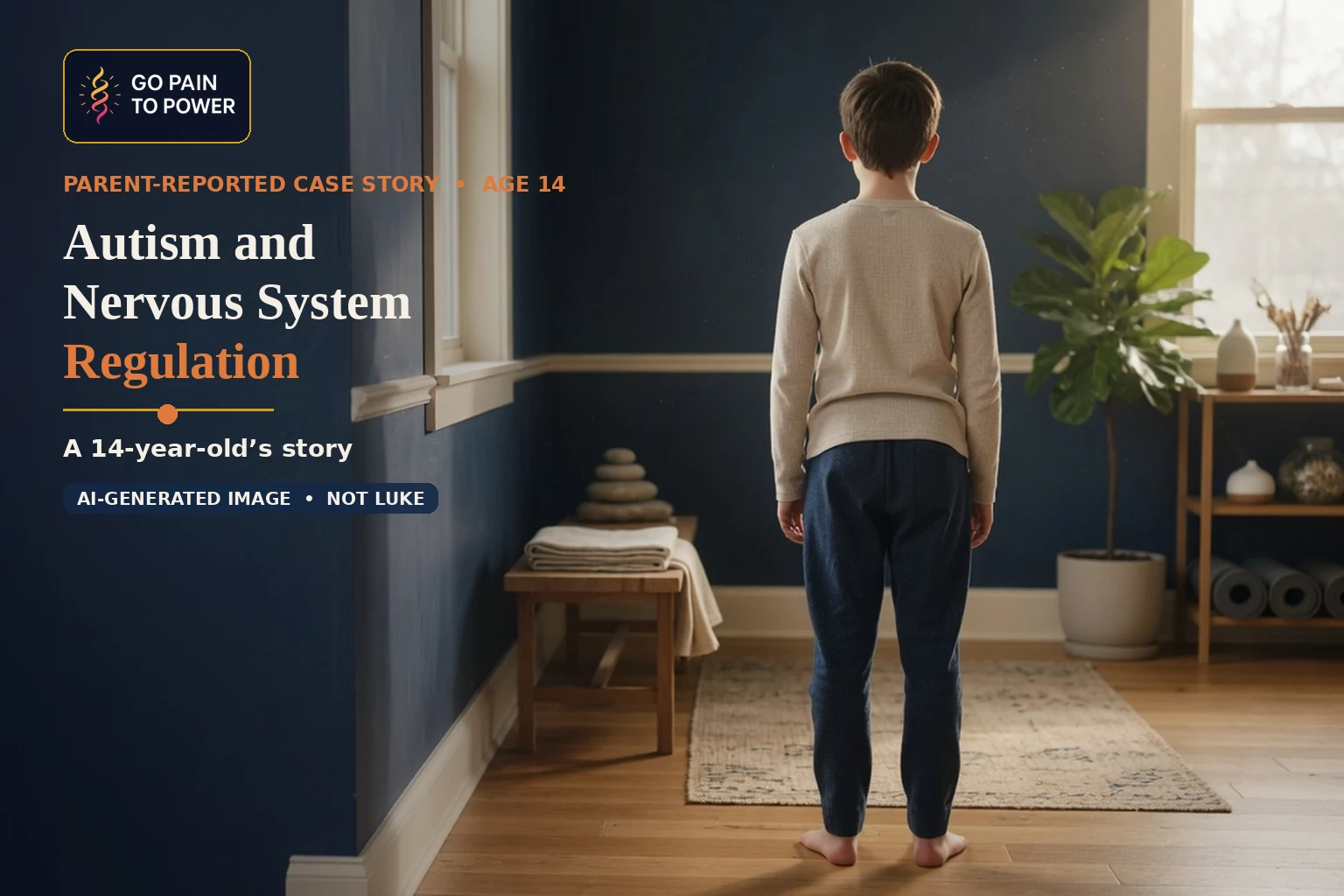
Luke is a 14-year-old with autism. His mother brought him to Go Pain to Power in San Antonio for a second nervous-system-focused wellness session after seeing meaningful changes at home following his first visit.
The clearest change was his teeth grinding. His mother said it stopped the day they left the first session and had stayed gone by the time they returned. She also reported that Luke seemed calmer, focused more easily, used three words, and showed better awareness of when he needed the restroom.
This is Luke’s story as his mother described it at the second visit, plus later observations a family friend shared in September and October 2026.
What nervous-system regulation means in everyday life
Nervous-system regulation is a way of talking about how the body responds to sensory input and stress, and settles again after feeling overwhelmed. The National Autistic Society explains that autistic people can be more or less sensitive to sensory input, such as sound, light, touch, or sensations inside the body. Reducing overwhelming input and finding calming activities that suit the person can help them manage sensory overload. This general sensory-processing context is separate from the family’s observations of Luke below.
Autism, nervous system regulation, and teeth grinding
For families searching for information about an autistic child’s teeth grinding, Luke’s experience offers a concrete parent perspective. Before his first session, he ground his teeth frequently enough that other family members knew the sound well.
At the follow-up, his mother gave a clear timeframe:
“He hasn’t grinded his teeth since the day we walked out of here,” she said.
She reported no teeth grinding between the first and second visits. Family members noticed the difference too. That change became one of the strongest reasons she wanted to continue exploring nervous system regulation with him.
At Go Pain to Power, nervous-system-focused sessions use gentle sensory input while paying close attention to how each person responds. Luke’s sessions moved at his pace, with his comfort and engagement guiding each activity.
Why Luke’s mother returned
Luke’s mother came back because the changes she saw extended beyond teeth grinding. By his second visit, she reported:
- No teeth grinding since the first session
- A calmer baseline and less hyperactivity
- Less rapid agitation
- Better eye contact and focus with her
- More verbalization, including three words
- Earlier recognition that he needed to use the restroom
The restroom change stood out in daily life. Luke had previously needed structured prompting and might recognize what happened only after an accident. His mother began seeing him recognize the need sooner and go on his own.
These were practical changes she could see and describe. Instead of a general impression that he seemed better, she identified behaviors the family could continue watching over time.
What Luke experienced during his second nervous-system session
Luke’s second session included gentle sound, vibration, visual tracking, and other forms of sensory input. The activities followed his responses and level of interest.
He wore a BrainTap sound-and-light headset for several minutes. His mother noticed him become calm while he wore it. The headset combined music, spoken audio, and light stimulation in a quiet part of the session.
Luke also engaged with tuning forks. With guidance, he activated a tuning fork, felt the vibration at several locations, and followed it visually as it moved. His mother described him as more centered and relaxed during this activity and said he stayed with it longer.
That level of engagement gave the session a useful direction: present sensory input gently, observe Luke closely, and continue with the activities that held his attention.
Restroom awareness during the second visit
During the visit, Luke appeared to recognize that he needed the restroom. He went, sat down, and completed a bowel movement with less prompting than his mother said he usually required.
His mother immediately compared it with his earlier pattern. Previously, an accident might happen first and he would ask for help afterward. This time, he responded to the need before that pattern played out.
For his family, that was another meaningful example of improved body awareness to track alongside teeth grinding, calmness, focus, and communication.
What Luke’s family is tracking next
Luke’s mother wants to keep watching the changes that brought them back while continuing to support the areas that matter most in his daily life. Their follow-up priorities include:
- Whether the absence of teeth grinding continues
- How often Luke appears calm and focused
- Whether verbal communication continues to grow
- How consistently he recognizes restroom needs sooner
- Changes in sleep, rocking, and humming
Tracking specific behaviors gives the family a clearer picture of Luke’s progress from one visit to the next.
Speech and communication: the family’s later observations
In September 2026, Michelle, a family friend who referred Luke’s family, described what she had been seeing and what his mother had been sending her.
She said Luke’s shoulders are more relaxed. She said his color had changed, that he had more life in him. After a later session, she said he had been articulating five- and six-word sentences.
“Even his shoulders are more relaxed, and like his color has changed. Like he just has like life.”
That is the same communication line his mother was already watching after visit two, when she reported three words. The later report is longer sentences, plus a body that looks less guarded.
October update: spontaneous speech and social play
In October, Michelle shared another update from Luke’s family. While playing with other children, Luke reportedly invited them upstairs: “Hey guys, let’s go upstairs and play.” When the adults expressed surprise, the children said he had already been talking with them outside on the trampoline.
Michelle also described him hugging and roughhousing with the other children. The update builds on the earlier reports of longer sentences: he was using speech to connect with other children and initiate an activity.
Nervous-system regulation support in San Antonio
Go Pain to Power offers individualized nervous-system-focused wellness sessions in San Antonio. Each visit is shaped around the person’s responses rather than a one-size-fits-all routine.
Families who want to understand the process can read how the nervous-system reset approach works and see what to expect during a session.
If Luke’s story feels familiar and you want to explore nervous system regulation support for yourself or a family member, request a private conversation or session.